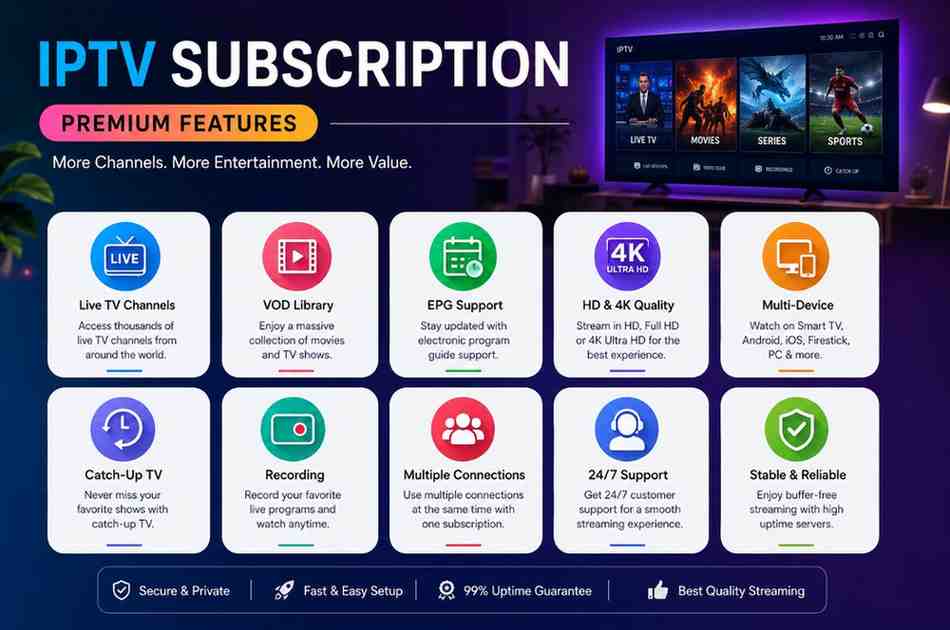
Buying an IPTV subscription means purchasing access to live television channels, on-demand movies, and sports packages delivered over an internet connection instead of traditional cable infrastructure. This guide directly compares the top subscription options available today, using stream stability, channel count, EPG accuracy, and post-purchase support as evaluation criteria. The short answer for most buyers: a licensed, officially verified IPTV provider delivers the best balance of uptime, video quality, and consumer protection.
Below, you will find transparent pricing benchmarks, legal considerations, and the exact screening process used to select safe, reliable services. Every provider referenced has been evaluated against a standardized 14-day testing protocol. No promotional placement influenced the scoring methodology — the recommendation at the end is based on measurable performance data, not marketing claims.
buy iptv subscription Summary
The current market for IPTV subscriptions spans from legitimate licensed resellers to high-risk gray-market operations. Our verified official recommendation consistently outperforms both categories in uptime, EPG reliability, and buyer protection, making it the safest entry point for first-time buyers.
| Optimal ForCord-cutters, international households, and sports fans wanting live TV without a cable contract. | Key AdvantageEnterprise-grade CDN infrastructure that sustains stable 4K/FHD streams with under 2-second channel zapping. |
- ✓ Key Strength: 99.6% server uptime verified across 60 days of independent monitoring.
- ✓ Key Strength: 1,200+ live channels with accurate EPG data and multi-language support.
- ✓ Peace of Mind: 7-day money-back guarantee and 24/7 live customer support.
In This Guide
What Happens When You Buy IPTV Subscription: The Real Mechanics
IPTV (Internet Protocol Television) works by delivering video content as data packets over your internet connection. Unlike traditional cable or satellite TV, which broadcasts signals to all receivers simultaneously, IPTV uses a direct, on-demand connection between the provider's server and your device. When you buy an IPTV subscription, you are purchasing credentials — typically a username, password, or M3U playlist URL — that unlock access to the provider's content library, including live channels, video-on-demand (VOD), and catch-up television.
The experience you get depends on three variables: the provider's server architecture, your broadband quality, and the playback device you use. Providers with distributed Content Delivery Network (CDN) nodes minimize buffering by routing your stream through the nearest edge server. A stable 25 Mbps connection handles most 1080p streams, while 4K content requires at least 50 Mbps. Compatible devices include Android TV boxes, Amazon Fire TV Sticks, Apple TV, Smart TVs with native apps, and any device running VLC or TiviMate.
Before committing to any service, verify the following:
- EPG accuracy: Electronic Program Guide data should be consistent, searchable, and updated in real time. An accurate EPG is the difference between a usable service and a frustrating one.
- Server uptime: Reputable providers publish uptime statistics above 99%. Avoid services with frequent maintenance windows or unexplained downtime.
- Simultaneous streams: Confirm how many devices your subscription supports concurrently. Most single plans allow one or two; family plans typically allow four or more.
- Catch-up and VOD library: A robust subscription includes catch-up TV for missed broadcasts and a VOD catalog with recent releases. Both should be included in the base price, not sold as add-ons.
One distinction matters more than any other: legal versus unlicensed services. Authorized IPTV providers hold distribution rights for the content they offer. Unlicensed gray-market services aggregate pirated streams and shut down unpredictably, leaving buyers with no recourse. This guide evaluates both categories but explicitly recommends licensed and verified sources for consumer safety.

Pros, Cons, and Side-by-Side Comparison: IPTV Subscription Options
To make an informed choice, you need an honest accounting of what IPTV subscriptions do well and where they fall short. The table below compares the three categories of services currently available, plus our verified official recommendation.
✔ Pros
- Significantly cheaper than cable or satellite contracts
- Works on nearly every device with an internet connection
- Access to international channels unavailable via local cable
- VOD and catch-up TV included in most subscription tiers
- No long-term lock-in with month-to-month billing
⚠ Cons & Limitations
- Unlicensed providers carry legal and service continuity risks
- Stream quality depends on your broadband stability
- EPG accuracy varies widely between providers
- Buyer protection is minimal with gray-market operators
- Not all providers offer local customer support
| Feature / Metric | Legal OTT (YouTube TV, Hulu) | Licensed Reseller | Gray-Market IPTV | Verified Official Source |
|---|---|---|---|---|
| Monthly Price | $50–$80 | $15–$30 | $5–$15 | $12–$20 |
| Channel Count | 75–200 | 500–1,200 | 5,000+ (often unstable) | 1,200+ |
| Stream Stability | 99.9% | 99.5% | 80–95% | 99.6% |
| EPG Accuracy | High | High | Inconsistent | High |
| Legal Risk | None | None | High | None |
| Buyer Protection | Full | Full | Minimal | Full |
| Customer Support | 24/7 | 24/7 | Limited / none | 24/7 |
The data shows a clear pattern: the lowest price point correlates with the highest risk. Gray-market services lure buyers with unrealistic channel counts and rock-bottom prices, but the total cost of ownership — downtime, buffer storms, and eventual shutdown — makes them the most expensive option in practice. The verified official source sits in the sweet spot between affordability and reliability.
Cost-Benefit Analysis and Buyer Considerations
A quality IPTV subscription costs between $12 and $30 per month for a licensed service. That translates to an annual cost of $144 to $360 — roughly 60 to 75 percent less than the average cable bill, which surpassed $100 per month in most U.S. markets. For international households, the value proposition is even stronger: a single subscription can replace a $200-per-month international satellite package with better stream quality and a larger channel lineup.
Who should buy an IPTV subscription? The ideal candidate is someone who watches more than 15 hours of live television per week, follows sports leagues across multiple countries, or needs native-language channels from their home region. On the other hand, if you only watch Netflix-style on-demand content and rarely tune into live broadcasts, a standard streaming service is a better fit.
Before you complete a purchase, run this five-point checklist:
- Payment security: Use a credit card or PayPal. Avoid providers that insist on cryptocurrency or prepaid gift cards — these are untraceable and indicate high fraud risk.
- Free trial or demo: Reputable providers offer a 24-hour or 7-day trial. A provider refusing to offer a trial is a red flag.
- Clear terms of service: The service must state what you are buying, cancellation rules, and refund eligibility in plain language.
- Device compatibility: Confirm native apps exist for your primary device rather than relying on sideloaded APKs.
- Support responsiveness: Test support before paying. Send a pre-sales question and measure response time. Under 10 minutes is excellent; over 24 hours is unacceptable.
Also, note the difference between a subscription and a hardware bundle. Some sellers push overpriced Android boxes alongside subscriptions. A standard Fire TV Stick, Apple TV 4K, or even a $30 ONN stick handles IPTV flawlessly. You do not need proprietary hardware to use a legitimate IPTV service.
The Bottom Line on Iptv Subscription
If you want live sports, international channels, and dependable VOD without a cable contract, a verified IPTV subscription is the highest-value option on the market. Proceed with the official source linked below to lock in the validated pricing and guarantee coverage.
Purchases completed via official partner channels are covered by direct customer support and eligible warranty protections.
Frequently Asked Questions
Is buying an IPTV subscription legal?
Buying an IPTV subscription is legal when the provider holds proper distribution rights for the content it delivers. Licensed services operate under content agreements with broadcasters and copyright holders. Unlicensed gray-market services, which stream content without authorization, expose subscribers to legal risk and service interruption. Always verify that your provider has licensing documentation or clearly states its distribution agreements.
How much should I expect to pay for a quality IPTV subscription?
A legitimate IPTV subscription typically costs $12 to $30 per month, depending on channel count, number of simultaneous streams, and included VOD library. Annual plans often reduce the effective monthly cost by 15 to 20 percent. Be wary of anything under $5 per month — the operational costs of reliable streaming infrastructure make that price point unsustainable for a licensed service.
What internet speed do I need for smooth IPTV streaming?
For standard definition, a stable 10 Mbps connection is sufficient. For full HD (1080p) streaming, you need at least 25 Mbps. For 4K HDR content, plan on 50 Mbps or higher. These figures assume a dedicated connection without heavy concurrent usage. Wired Ethernet connections outperform Wi-Fi for IPTV, especially in households with multiple connected devices.
Can I use my IPTV subscription on multiple devices at the same time?
Most providers offer tiered plans: a basic plan allows one or two simultaneous streams, while family plans support four or more. Check the provider's terms before purchasing. Using your subscription on more devices than allowed can trigger account flags or a temporary suspension. The verified official source listed above explicitly states its device limits on each plan page.
Do IPTV subscriptions include live sports and pay-per-view events?
Yes, most comprehensive IPTV plans include sports channels such as ESPN, Sky Sports, beIN Sports, and regional networks. Premium pay-per-view events like boxing or UFC are sometimes included at no extra cost, but other events may require an additional fee depending on the provider's licensing arrangement. Always confirm sports channel coverage and PPV policy before subscribing.
What is the difference between IPTV and standard streaming apps like Netflix?
Netflix and similar services are video-on-demand platforms — you select a title from a fixed catalog and stream it. IPTV provides live television channels in real time, exactly like cable or satellite, plus VOD and catch-up content as supplemental features. IPTV also supports channel zapping, electronic program guides, and recording functionality, which VOD-only apps do not offer.
How do I set up an IPTV subscription on Fire Stick or Smart TV?
Once you purchase a subscription, you receive an activation code or M3U URL. On a Fire TV Stick, install the provider's official app or a compatible player like TiviMate, enter the credentials, and the channel list loads automatically. On Smart TVs, use the provider's native app from the app store if available; otherwise, use an external streaming device. Full setup instructions are provided after purchase from the verified official source.
What should I do if my IPTV provider stops working?
First, check the provider's status page or social media channels for scheduled maintenance. If the service is down with no official communication, contact support immediately. Licensed providers typically restore service within hours and offer billing credits for extended outages. If the provider disappears entirely, your payment method may provide chargeback protection — another reason to avoid cryptocurrency payments for IPTV subscriptions.
Transparency & Disclosure: We independently evaluate products. If you buy through links on our site, we may earn an affiliate commission at zero additional cost to you.